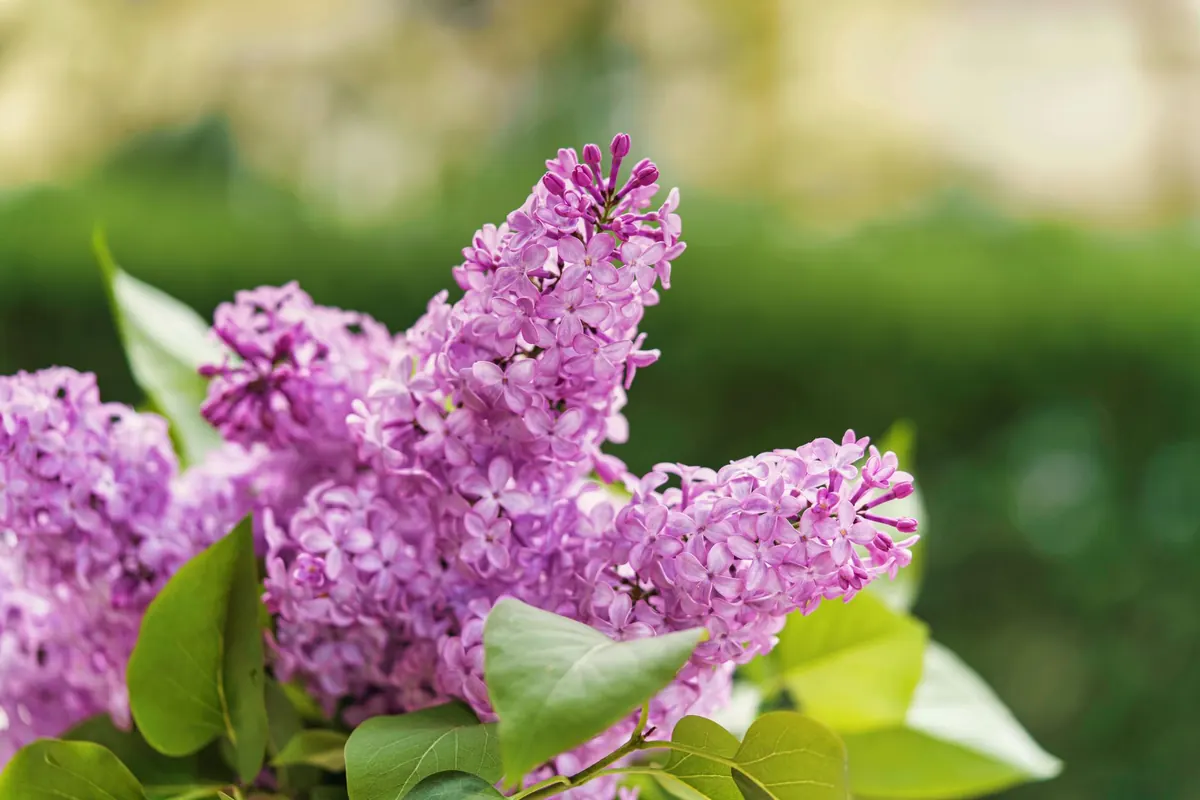
Designing with Lilacs: Colour Pairings and Companion Plants

A lilac in full flower is hard to improve on. For two or three weeks in May it carries the whole garden: heavy cones of bloom, scent drifting over the lawn, bees working the heads from first light. Then it stops, and for the rest of the year you are left with a large, coarse-leaved shrub and rather a lot of empty space beneath it. Designing with lilacs is really about planning for those other months as carefully as the fortnight that justifies the whole exercise.
Start by knowing which lilac you have
Common lilac, Syringa vulgaris, is the big one: three to four metres in time, sometimes more, flowering in May on wood that grew the previous year. Its leaves are large and heart-shaped, its habit upright and open, and it is famously bare around the ankles. That bare base is the most useful thing to know about it, because it dictates what you plant in front.
Smaller and far easier to place are the Meyer lilacs, of which 'Palibin' is the standard choice: roughly a metre and a half, compact, with small leaves and dense trusses of pale lilac-pink, often followed by a lighter second flush in late summer. Syringa pubescens subsp. microphylla 'Superba' is similar in scale, with soft pink buds opening to pinkish lilac. If your border cannot take a four-metre shrub, these are the ones to look for.
Colour matters more than people expect. The named forms run from 'Madame Lemoine' (creamy white) and 'Primrose' (pale yellow) through 'Sensation' (violet edged in white) to 'Charles Joly' (deep purple-red) and 'Esther Staley' (clear magenta-pink). A magenta lilac behaves like a hot colour in a border; a white one behaves like a light. Plan accordingly.
One practical detail: most named lilacs are grafted onto common lilac rootstock, which means they will throw suckers from below the graft. Those suckers are vigorous, plain-leaved and, if left, will eventually swallow the named variety you paid for. Pull them off at the base while they are small, or cut them cleanly at ground level, and do it in early summer when the sap is rising and the wound heals quickly. If you are planting a lilac in a small garden, it is worth asking for a plant grown on its own roots, which avoids the problem altogether.
Colour pairings that hold together
- Lilac with lime and chartreuse. Acid greens lift lavender-blue out of the pastel doldrums. Euphorbia characias subsp. wulfenii, Alchemilla mollis and the golden elder Sambucus racemosa 'Sutherland Gold' all do this without competing for attention.
- Lilac with wine and plum foliage. Physocarpus 'Diabolo', Cotinus 'Grace' and purple berberis give a deep backdrop that makes pale lilac look crisp rather than washed out. Best used behind the lilac, not crowding beside it.
- Lilac with silver. Stachys byzantina, Artemisia 'Powis Castle', lavender and the grey leaves of rosemary sit comfortably with every lilac colour, including the whites.
- Lilac with white. A white lilac partnered with white honesty, Tulipa 'Purissima' or Narcissus 'Thalia' is quietly effective in a way that photographs badly and looks lovely in person.
- Lilac with blue. Camassia leichtlinii, Nepeta 'Six Hills Giant' and Geranium 'Johnson's Blue' extend the lavender theme without simply repeating it. Shift the tone by a shade or two in either direction and the border reads as a scheme rather than a match.
What to be cautious about: put magenta lilac beside orange and apricot tulips and you have an argument on your hands. That is not a rule against it — strong contrast can be thrilling — but it has to look deliberate, and a single clash usually just looks like a mistake.
There is also the question of quantity. A single lilac in a mixed border reads as a specimen; three in a row read as a hedge, which is a different design decision altogether. If you are using more than one, repeat the same variety rather than mixing colours, and let the flowering period be brief and emphatic rather than drawn out and muddled.
Filling the gap underneath
Because lilac flowers on old wood, you cannot cut it back hard in winter to keep it small without losing the flowers. The alternative is to hide the bare stems with plants that grow up around them. Herbaceous perennials that emerge late are ideal, since they will not smother the new shoots in March and April.
Good candidates for the shadow of a lilac: hardy geraniums, aquilegia, Japanese anemones, Knautia macedonica, Sanguisorba and the taller salvias. Around the edge of the canopy, where the roots are less greedy, plant ferns and fine grasses — Dryopteris erythrosora and Deschampsia cespitosa — whose texture contrasts sharply with the big lilac leaves.
Spacing matters here. Lilac roots are shallow and greedy, and they will steal water and nutrients from anything planted within a metre of the trunk. Keep the closest perennials at least 60cm from the main stem, and plant them in soil improved with compost so they have a fair start. In the first two summers, water the companions rather than the lilac; once established, the shrub will look after itself.
Bulbs carry the first half of the year
Bulbs are the simplest way to buy time while perennials are still waking up. Narcissus in April, then tulips, then Camassia and Allium hollandicum 'Purple Sensation' in late May, each taking over as the last fades. Plant them in generous drifts rather than neat rows; a line of twenty daffodils looks like an accident, sixty in a loose clump looks like a decision.
If the lilac sits in lawn, resist the temptation to tidy the bulb foliage away in June. The leaves need six weeks to feed next year's flowers, and the lilac's own leaves will hide the yellowing tips soon enough.
Keeping the border alive after the flowers go
By July the lilac is green and static. That is the moment the rest of the planting has to earn its keep. Verbena bonariensis, Salvia nemorosa 'Caradonna', Knautia macedonica and the autumn asters will carry colour into September, and the lilac foliage becomes a solid dark backdrop that sets them off rather than a feature in itself.
Late-season perennials are not just filler. They are the reason the border still has a shape in October, when the lilac is just a dark mass and the ground beneath it is wet and bare. Choose plants with strong silhouettes — the vertical spires of Salvia, the dark buttons of Knautia, the airy clouds of Verbena — so that even when colour fades, the structure remains.
Three combinations to copy
1. The classic May pairing
Pale lilac Syringa vulgaris with Allium 'Purple Sensation' at its feet and Alchemilla mollis frothing around the ankles. Add a drift of Camassia leichtlinii for a fortnight of blue, and let the alchemilla seed into the gaps. This is the combination that makes a small front garden look as though it has been there for a century.
2. The dark and dramatic border
Deep purple 'Charles Joly' or magenta 'Esther Staley' backed by Physocarpus 'Diabolo' and underplanted with Geranium 'Ann Folkard' and Salvia nemorosa 'Caradonna'. The wine-dark foliage holds the hot lilac in check, and the geranium's acid-green leaves pick up the light. Where the border turns a corner, repeat the salvia to tie the two sides together.
3. The white and silver garden
White 'Madame Lemoine' with Stachys byzantina, Artemisia 'Powis Castle', Nepeta 'Six Hills Giant' and white alliums. In evening light this planting glows long after the sun has gone, and the scent of the lilac carries further in the cool air. It is a restrained scheme that never looks dull.
Pruning, deadheading and renovation
Lilacs flower on wood made the previous year, so the golden rule is to prune immediately after flowering, never in winter. Remove the spent trusses and cut back one or two of the oldest stems to the base each year; over three or four years this renews the shrub without sacrificing bloom. If a lilac has been left to grow into a thicket, renovate it over three winters rather than one, taking out a third of the old wood each time. Deadhead if you want a tidier look, but leave a few heads to set seed if you want the winter silhouette of dry capsules against the sky.
Small gardens and containers
If you have only a balcony or a small courtyard, 'Palibin' or 'Superba' will grow happily in a large pot for many years. Use a soil-based compost, top-dress each spring, and water regularly through the growing season. The plant will stay compact, flower reliably, and give you the scent without the four-metre shadow. In a pot, pair it with a low carpet of thyme or a single clump of heuchera — anything more will compete for the limited root space.
Designing with lilac is an exercise in patience and proportion. Give it room, choose its companions for the ten months it is not in flower, and resist the urge to crowd it. Done well, it earns its place twice over: once in May, and again in every quiet month when the shape of the border depends on the plants you chose to keep it company.
Photo: aimeev83 / Pixabay